GPS Tracker vs AirTag for Pets: Which Is Better in Australia?
Apple AirTags have become a popular low-cost way for pet owners to keep tabs on cats and dogs — but are they actually a good alternative to a real pet GPS tracker in Australia?
While AirTags can work in very specific situations, they are fundamentally different from true GPS trackers. Understanding those differences is critical before trusting one to locate a roaming pet.
Below, we break down how AirTags really work, their limitations in Australia, and when a dedicated GPS tracker is the better choice.
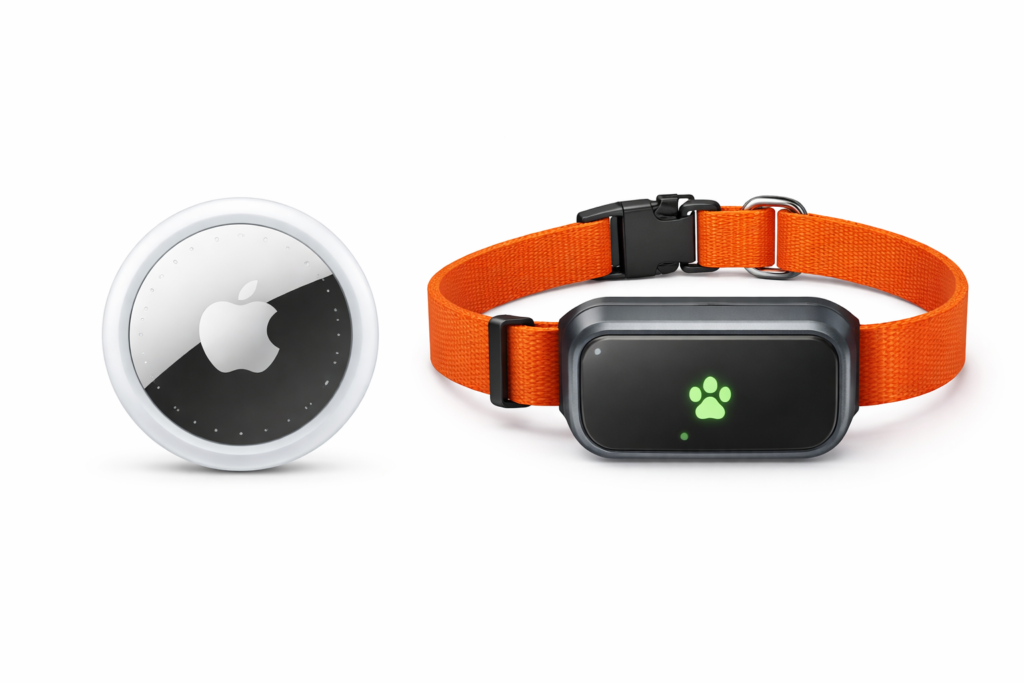
Quick Comparison: Dedicated Pet GPS Tracker vs Apple AirTags
Feature | Dedicated Pet GPS Tracker | Apple AirTags |
Tracking technology | GPS + cellullar (LTE-M / 4G) | Bluetooth + Find My network |
Live location tracking | Yes | No |
Update frequency | Continuous / adjustable | Irregular, device dependent |
Range | Unlimited (with mobile coverage) | Limited to nearby Apple devices |
Urban performance | Strong | Moderate |
Regional / rural performance | Moderate to strong (coverage dependent) | Weak |
Real-time recovery | Yes | No |
Battery life | Days to weeks (usage dependent) | Months |
Subscription required | Yes | No |
Designed for pets | Yes | No |
Best use case | Active, roaming pets | Low-cost, short-range monitoring |
What AirTags Are Designed For
AirTags were created to solve a simple problem: helping people find everyday items that get misplaced, such as:
- Keys left on the kitchen bench
- A backpack forgotten at a café
- Luggage that didn’t come off the carousel
They excel in these scenarios because the items are usually stationary or slow-moving and only need to be located occasionally, not tracked continuously.
Pets are a very different use case. Cats and dogs move constantly, cover unpredictable distances, and can disappear quickly if they slip out of sight. While an AirTag can be attached to a collar, it wasn’t designed with live pet tracking in mind — and Apple doesn’t position it as a tracking solution for animals.
That difference becomes especially important once you understand how AirTags actually determine and update location, and why that method has clear limitations for tracking pets.
How AirTags Track Pets (Bluetooth Limitations)
AirTags don’t use GPS to track location. Instead, they rely on Bluetooth and Apple’s Find My network, which works by detecting nearby Apple devices and anonymously relaying location data.
In practice, this means an AirTag can only update its location when:
- It comes within Bluetooth range of an iPhone, iPad, or Mac
- That device has network access to report the location
- The pet passes through an area with enough Apple users nearby
If none of these conditions are met, the AirTag simply doesn’t update.
This system can work in busy areas, but it introduces clear limitations for pet tracking:
- No live or continuous tracking
- Delayed or irregular location updates
- Gaps in coverage when Apple devices aren’t nearby
- Limited reliability for fast-moving pets
For cats and dogs that roam unpredictably, this lack of consistent updates can make Bluetooth-based tracking feel reassuring one moment — and unreliable the next.
Range Limits in Australia (Urban vs Regional)
Because AirTags rely on nearby Apple devices to update their location, performance varies dramatically depending on where your pet roams.
In urban and suburban areas, AirTags tend to perform better because:
- There is a high density of iPhones and other Apple devices
- Location updates occur more frequently
- Movement is more likely to be captured passively
In these environments, AirTags can appear surprisingly effective — especially for pets that stay close to populated streets or neighbouring homes.
In regional or semi-rural areas, the limitations become far more obvious:
- Fewer Apple devices within Bluetooth range
- Larger gaps between location updates
- Increased chance of no location data at all
Once a pet moves into bushland, open parks, or low-density areas, AirTag tracking becomes inconsistent and unreliable.
This difference in coverage is why AirTags may feel “good enough” in some city settings, yet fall short when reliable tracking is needed most.
Real-World AirTag Performance on Cats & Dogs
In real-world use, AirTags:
- Do not provide live tracking
- Do not update consistently
- Often show delayed or outdated locations
They can be useful if:
- Your pet stays close to populated areas
- Someone with an iPhone walks past shortly after your pet moves
They are not reliable for:
- Escaped pets
- Long-distance roaming
- Emergency recovery situations
Privacy & Safety Concerns
Apple includes anti-stalking protections with AirTags, which can cause issues for pet tracking.
Potential problems:
- AirTags may emit audible alerts
- iPhones can notify people that an AirTag is “moving with them”
- Location sharing can be inconsistent
These features are designed to protect people — not pets — and can reduce effectiveness in real tracking scenarios.
Subscription vs No Subscription
One major reason people choose AirTags is that:
- There is no subscription fee
Dedicated GPS trackers, on the other hand, require subscriptions to cover:
- Mobile network access
- Server infrastructure
- App functionality
While subscriptions add ongoing cost, they also enable:
- True real-time tracking
- Unlimited range
- Reliable updates
When AirTags May Be a Suitable Option
AirTags can be a reasonable option if:
- Your pet stays close to home
- You live in a dense urban area
- You want a very low-cost backup
- You understand the limitations
They are best treated as a supplement, not a primary tracking solution.
When You Need a Real GPS Tracker
A dedicated GPS tracker is the better choice if:
- Your cat or dog roams regularly
- You live outside major city centres
- You want real-time tracking
- You need reliable recovery in emergencies
True pet GPS trackers use:
- GPS satellites for positioning
- Cellular networks (LTE-M / 4G) to transmit data
- Purpose-built apps designed for pets